
Learning to see the person in front of us the way Jesus does
There are some pictures that become more than pictures. They capture a moment, but somehow, years later, they still speak.
This is one of those pictures for me.
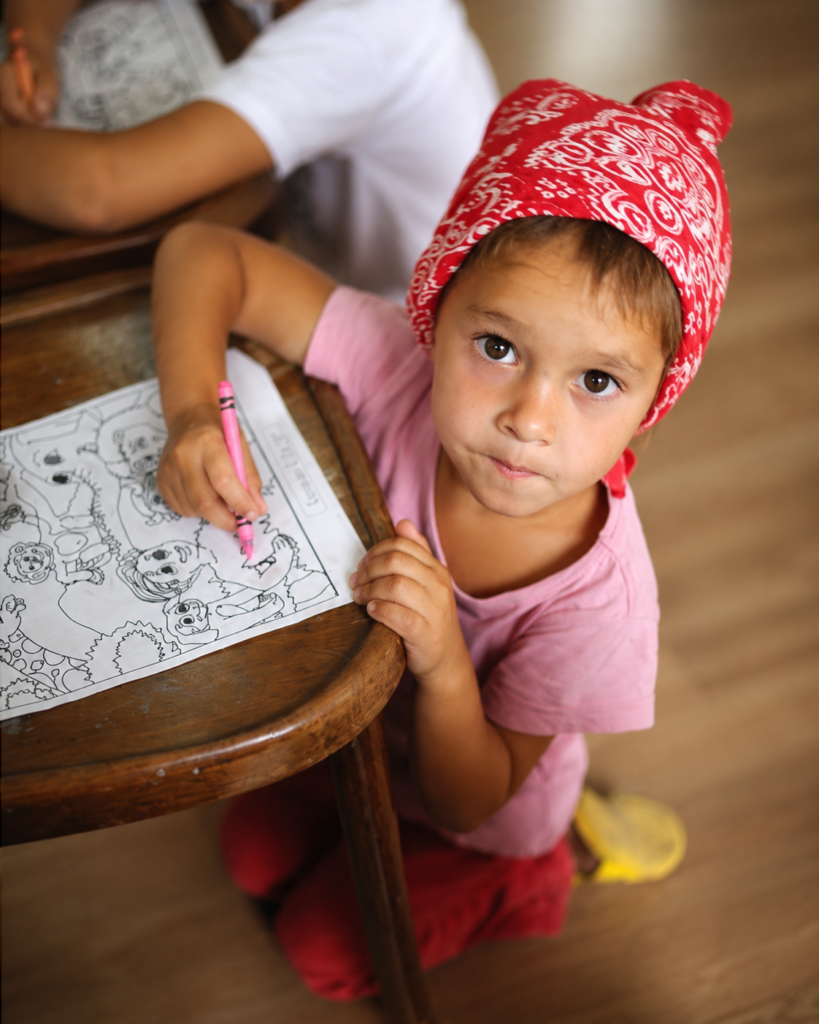
It was 2015, and I was in Romania on my very first international mission trip. Not only was it my first mission trip outside of the United States—it was the first mission trip I had ever led. We were a VSM team traveling from village to village, doing Vacation Bible School with children. We would sing and worship together, share a Bible lesson, and then rotate the children through crafts and games. There was no big stage or elaborate production. It was simply the Gospel, a team willing to serve, and children who needed to know that Jesus loved them.
I remember this particular village church. The sun was shining, children were everywhere, and the room was full of activity. There weren’t rows of nice tables and chairs. The kids were gathered around little wooden chairs, using them for whatever they needed as they worked on their crafts and coloring pages.
And sitting there was this little girl.
She had on a pink shirt and a red head scarf, with a pink crayon in her hand. At some point, she looked up, and I took this picture.
I had no idea then how much that moment would mean to me years later. I didn’t know that God was beginning something in my heart that would eventually change the direction of our entire lives. That trip in 2015 was the beginning of God calling me to Romania. Pam wasn’t with me on that first trip. She would come the following year, in 2016, and God would begin stirring her heart too. Candra Barnett was there in 2015. It was her second trip to Romania and my first. None of us could have known then that Candra would eventually serve alongside us here for more than seven years.
We didn’t know the whole story yet.
God did.
Sometimes God begins writing a story long before we realize we are standing in the middle of it.
And when I look at this picture today, I don’t just see a little girl doing a craft at a Vacation Bible School. I see a person. And I think that is something we desperately need to learn again.
Jesus Saw People
Matthew tells us:
“When he saw the crowds, he had compassion for them, because they were harassed and helpless, like sheep without a shepherd.”
— Matthew 9:36, ESV
Jesus saw the crowds, but He never lost sight of the person.
That matters, because it is easy for us to see crowds. Missionaries can talk about numbers. Churches can talk about attendance. Ministries can talk about projects. We can talk about how many people were fed, how many children came to VBS, how many Bibles were handed out, how many people heard the Gospel, or how many villages we entered. Those numbers matter because every number represents someone, but we can never allow the numbers to become more important than the people.
Every number has a name. Every face has a story. Every person matters to Jesus.
Jesus didn’t look at a crowd and just see a crowd. He saw people who were hurting. He saw people who were lost. He saw people carrying things nobody else could see. He saw people who needed a Shepherd.
And He had compassion.
Learning to See Differently
Before becoming a missionary, I spent fourteen years in law enforcement. In law enforcement, you learn to assess people quickly. You walk into a situation and immediately begin looking. Who is a threat? Who is nervous? Who is telling the truth? Who might be hiding something? What happened here? What could happen next? You learn to notice clothing, behavior, body language, surroundings, vehicles, hands—everything. There is a reason for that. Sometimes your safety and the safety of others depend on being able to make those assessments quickly.
But the danger is that we can begin doing something similar in everyday life. We size people up. We categorize them. We label them. We decide who they are before we ever know their story.
Poor. Addict. Homeless. Roma. Troublemaker. Immigrant. Rich. Broken family. Different religion. Different culture. Different politics. Different from me.
And once we have placed someone in a category, it becomes incredibly easy to stop seeing the person.
Jesus didn’t do that.
Jesus saw beyond what everyone else saw. He saw Zacchaeus in the tree when everyone else saw a corrupt tax collector. He saw the woman at the well when everyone else saw her reputation. He saw Bartimaeus when everyone else heard an interruption. He saw children when the disciples saw an inconvenience. He saw a woman caught in sin when the religious leaders saw a case to prosecute.
Jesus saw people.
The world sees labels. Jesus sees people.
Gospel Eyes
I have used this phrase for years:
We need gospel eyes.
And the more I think about it, the more I believe gospel eyes are really Jesus’ eyes. If we are going to gospelize the world, we have to learn to see the world the way Jesus sees it.
To gospelize, we have to have Jesus’ eyes.
Eyes that look beyond the outside. Eyes that see beyond the label. Eyes that refuse to reduce someone to their worst decision. Eyes that notice the person everyone else walks past. Eyes that see hurt underneath anger, loneliness underneath addiction, fear underneath resistance, and someone made in the image of God underneath everything else the world may see first.
That doesn’t mean pretending sin isn’t sin. Jesus never did that. But Jesus could look directly at someone’s sin and still see someone worth loving.
That is Gospel vision.
The Person in Front of You
When I took this picture in 2015, I didn’t know this little girl’s whole story. I still don’t. I don’t know where life has taken her or what she has walked through since that day.
But I know this:
Jesus knew her name.
Jesus knew her story.
Jesus knew every hurt, every fear, every dream, and every day that was ahead of her.
And He loved her.
That little girl was not a ministry project. She wasn’t a statistic from a mission trip. She was a person Jesus loved.
People are not projects. They are people Jesus loves.
And so is the person sitting across from you. So is the person working the register. So is the person standing on the street corner. So is the teenager everybody has given up on. So is the person whose life is a mess. So is the person who annoys you. So is the person who doesn’t look like you, talk like you, vote like you, worship like you, or come from where you come from.
The Gospel changes the way we see people.
Because once we understand how Jesus looked at us—with all of our sin, brokenness, failures, and need for grace—we cannot look at others the same way.
There is a world around us filled with people who are harassed and helpless, wandering like sheep without a shepherd. We can walk past them. We can label them. We can judge them from a distance.
Or we can ask Jesus to give us His eyes.
Eyes that see. A heart that feels compassion. And feet willing to go.
See the person. Love the person. Share the Gospel with the person.
Because the mission field is not only somewhere across an ocean.
Sometimes the mission field is standing right in front of you.
To gospelize, we have to have Jesus’ eyes.
And it starts with the one in front of you.