
Eight years ago, some of our first ministry experiences in Romania took us into Roma communities. Now God is bringing us back—not to start over, but to build on what He began.
“My dear brothers and sisters, how can you claim to have faith in our glorious Lord Jesus Christ if you favor some people over others?” — James 2:1 (NLT)
James reminds us that genuine faith in Christ leaves no room for favoritism. Every person is made in the image of God, and every one of us is equally in need of His saving grace.
The Gospel is for all.
I can still remember standing in the middle of a Roma community here in Romania during one of my first experiences ministering among the Roma. It was summertime. It was hot. The sun was shining, people were gathered all around us, and I was standing there with my Bible trying to share the Gospel.
And there was absolutely nothing quiet about it.
People were talking. Some were yelling back and forth. Chickens were running between our legs, and at one point a dog took off after one of the chickens. A little boy kept riding his bicycle back and forth through the crowd, weaving between people, until his grandmother apparently decided she had seen enough and backhanded him right off the bicycle. I remember standing there thinking to myself, Boy, we are definitely not in Arkansas anymore.
Then, just when I thought things couldn’t get much more interesting, somebody’s horse and buggy came trotting through the middle of everything, and we had to move out of the way. All the while, a Roma grandmother nearby was in a full-blown yelling match with a younger woman. It was loud, chaotic, and completely different from anything I had ever experienced.
And I loved it.
Because in the middle of all that commotion, something else was happening. There were people standing there listening—really listening. While chickens ran around us, children played, people talked, and life happened on every side of us, there were men and women whose eyes stayed fixed on me as I opened the Bible. They were listening to the Word of God. They wanted to hear more.
Looking back now, I don’t think I fully understood what God was beginning in my own heart that day.
Who Are the Roma?
When we first came to Romania, I honestly didn’t understand very much about the Roma people myself. Even today, when I talk about the Roma in America, I usually have to explain who I’m talking about because people hear the word Roma and sometimes assume I’m talking about Romanians.
I’m not.
The Roma are a distinct ethnic people found throughout Romania and across Europe. They are Europe’s largest ethnic minority, and throughout their history many Roma communities have experienced tremendous prejudice, discrimination, poverty, and social exclusion. Their ancestors originated on the Indian subcontinent and migrated westward centuries ago, eventually establishing communities throughout Europe.
In America, many people would recognize them by the older English term “Gypsies.” That word developed historically from the mistaken belief that the Roma had come from Egypt. Today, Gypsy can carry negative or derogatory meaning, which is one reason I normally use the word Roma.
Here in Romania, you will also hear the Romanian word țigan, pronounced roughly for an American as “tsee-GAHN.” Over the years, I’ve learned that even the terminology isn’t always simple. I’ve personally known Roma people who use țigan when referring to themselves, while others strongly dislike the word and prefer Roma. Because of that, I try to be respectful and simply use Roma unless someone tells me differently.
But after eight years here, they’re not really a category to me anyway.
They’re people.
They’re friends. They’re families whose homes I’ve sat inside. They’re children I’ve watched grow, men I’ve prayed with, mothers and grandmothers I’ve listened to, and people whose stories have become intertwined with ours.
What You Don’t See in the Picture
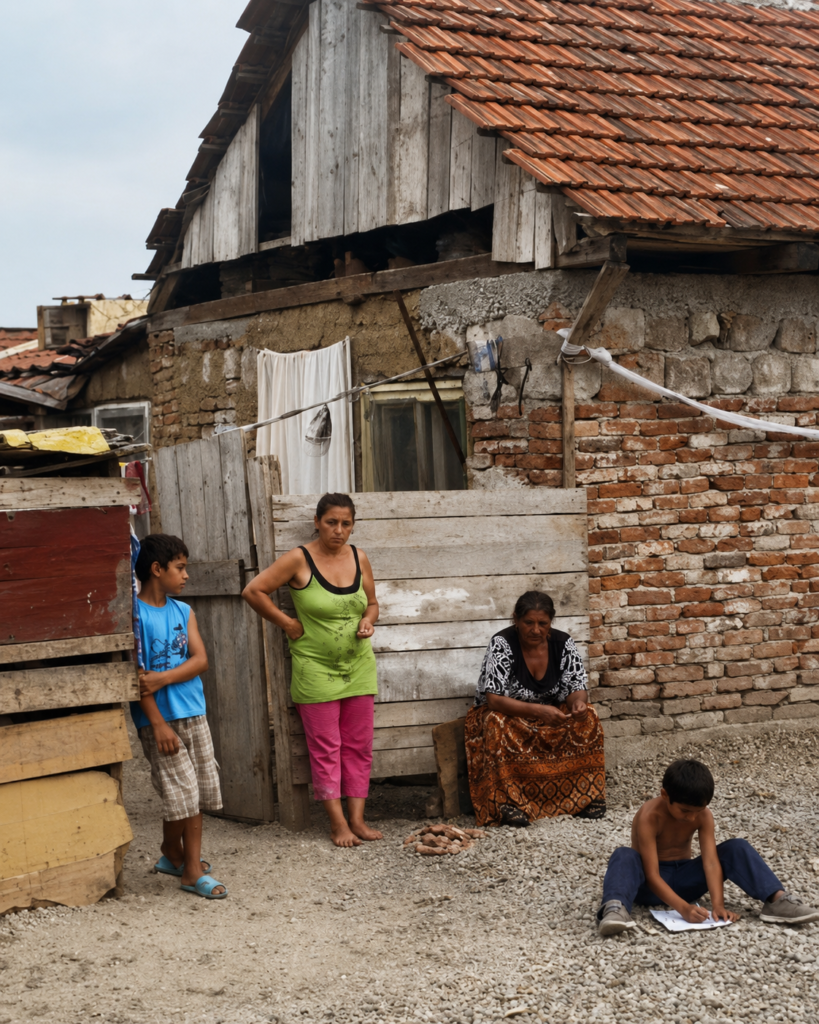
The photograph with this article was taken during those early years of ministry. If you only look at the picture, you might notice the old brick, wooden boards, gravel, bare feet, and the condition of the house. Depending on where you come from, it would be easy to glance at a photograph like this and think you understand the story.
But you don’t.
Because you can’t see what happened after the picture.
That family invited me into their home. They began telling me about things they were facing—sicknesses, needs, and burdens they were carrying—and then they asked me to pray. So I stood there in their home and prayed with them. I prayed for their family, for the specific needs they had shared with me, and for healing in the areas where they were sick.
There is something else I’ve noticed through the years that a photograph like this doesn’t show very well. A lot of these houses are rough. Some have leaking roofs, bad floors, walls that are falling apart, or very little heat. But I’ve walked inside home after home like this, and one thing has always stood out to me: they keep their homes clean. You can tell they’re proud of their home and that they take care of what they have. Folks can miss that if all they do is glance at the walls.
Somewhere along the way, the Roma stopped being a “people group” I had come to minister to. They became people with names, families, fears, hopes, sicknesses, children, and prayers.
That’s something a photograph will never fully show you.
The Stereotypes Are Easy
There are plenty of stereotypes surrounding the Roma, and I’ve heard them for years. People sometimes immediately think about begging or panhandling. They think about petty crime. They think about poverty. And I won’t pretend problems don’t exist in some Roma communities. They do. I’ve seen some of those problems myself.
But here’s the thing: brokenness isn’t unique to the Roma. Spend enough time in any culture—including my own—and you’ll find sin, addiction, broken families, crime, and people making bad decisions. It is easy to look at the failures of another culture and somehow forget how much brokenness exists in our own.
I’ve also seen just how deeply prejudice against the Roma can run. I remember a Romanian Baptist pastor once telling me what he considered a joke. He asked me, “What’s the best way to keep a Gypsy saved?” I didn’t know what he was getting at. He answered, “When you baptize him, don’t lift him back out of the water.”
I didn’t laugh.
I remember thinking how sad that was. I don’t necessarily believe that pastor literally wanted harm to come to anyone, but even as a joke, it exposed something deeper—the idea that somehow a Roma person could never really be good enough, that sooner or later they would fail.
But that isn’t the Gospel.
None of us are good enough. Not the Roma. Not the Romanian. Not the American. Not me. We don’t earn salvation by becoming good enough. We are saved by the grace of God through faith in Jesus Christ. If the ground is level at the foot of the cross, then there isn’t a separate Gospel for the Roma.
There is one Gospel. One Savior. And every one of us desperately needs Him.
I’ve met Roma husbands who work long days in construction to provide for their families. I’ve met men who farm and work with their hands. I’ve met mothers and grandmothers doing everything they can to care for their children. And now we’re meeting Roma men who want to know the Bible more deeply and be equipped to teach it to others.
That’s part of their story too.
And Then There Are the Hard Days
I don’t want to romanticize ministry either, because there have been plenty of difficult moments. Not long ago, we pulled our ministry van into a Roma village with a mission team to do a children’s program. Like they often do when we arrive, the kids came running. They surrounded the van, yelling, laughing, and excited about what we were getting ready to do.
I rolled my window down, and several Roma boys climbed up along the side of the van. I smiled at them and said in Romanian, “Ce faci?” In that setting, it’s basically like saying, “Hey, what’s up? How are you doing?” I expected something like, “Bine! Bine!”—“Good! Good!”
Instead, they apparently decided it was time to demonstrate everything they knew in English.
Unfortunately, their English vocabulary consisted of just about every four-letter curse word you could imagine. One after another. They were pretty proud of themselves too. And just in case their English vocabulary wasn’t clear enough, some of them had also learned the hand gestures that went along with it.
For a second, you almost don’t know whether to laugh from the shock of it or ask yourself, Where in the world did they learn all of this? But underneath the shock, I remember feeling something else—sadness. These were children, and somewhere along the way, those were some of the English words they had learned.
There have been times when children disrupted programs. There have been times when they didn’t listen. There have been times when ministry among them has been messy and difficult. But through the years, I’ve learned something important:
You don’t have to reach everybody for it to matter.
If twenty children are running around and only two are really listening, those two matter. If one child hears the Gospel and begins asking questions about Jesus, that child matters. If one little boy remembers a Bible verse after we’ve gone home, it mattered. If one little girl begins to understand that she was created by God and that she, just like all of us, needs the Savior, it mattered.
We plant the seed. God gives the increase.
Eight Years Later
When Pam and I came to Romania eight years ago, some of our first ministry was among the Roma. I don’t think we understood then how deeply God would weave these people into the story He was writing with our lives. And now, eight years later, as our ministry is changing shape, God is bringing us right back to where so much of it began.
But we’re not going back to start over.
We’re going back to build on what God has already begun.
One of the major areas ahead of us will be Bible seminary training among Roma men—helping equip men with a deeper understanding of God’s Word so they can teach, preach, disciple others, and serve their own communities. We’ll also continue ministering among Roma children, showing up in the villages, building relationships, and sharing the Gospel.
And we won’t be doing it alone. We’ll continue partnering with our ministry partner Candra Barnett, along with others who have faithfully served and loved Roma communities and who will continue walking alongside them. Together, we want to keep showing up—training men, teaching children, building relationships, and sharing Jesus.
It isn’t always flashy, and sometimes it’s slow. Sometimes it’s chaotic. Sometimes there are chickens running between your legs, a horse and buggy coming through the crowd, a grandmother knocking a kid off his bicycle, and another one yelling at somebody across the street.
And sometimes you’re sitting quietly inside someone’s home praying for God to heal them.
That’s ministry.
I think back to those first days sometimes and smile. Back then, there were moments when I probably thought, Lord, what in the world am I doing here? Eight years later, I can see things differently.
God was planting something.
And perhaps that is what I love most about this season. Back where it began doesn’t mean back to square one. It means back to the roots, back to relationships, back to people we love, and back to a work God started years ago—a work He isn’t finished with yet.
Ultimately, these aren’t ministry projects. They’re not statistics for a newsletter or photographs to show people back home. They’re people. Families with names and stories. People created in the image of God. People who need the same Savior I need. And people we still have the privilege of walking alongside.
So as this next chapter begins, pray for them. Pray for the children. Pray for the men who will study God’s Word. Pray for the families. Pray that doors continue to open and that, through all of it, Jesus will be made known.
God was working here long before us, and He will continue working long after us. We simply want to remain faithful wherever He allows us to be part of what He is doing.
We are still on mission.